
The Hidden Cost of Keeping Hardware Projects “On Track”
If you’ve ever worked on a hardware team, you’ve probably heard the question:
“Are we on track?”
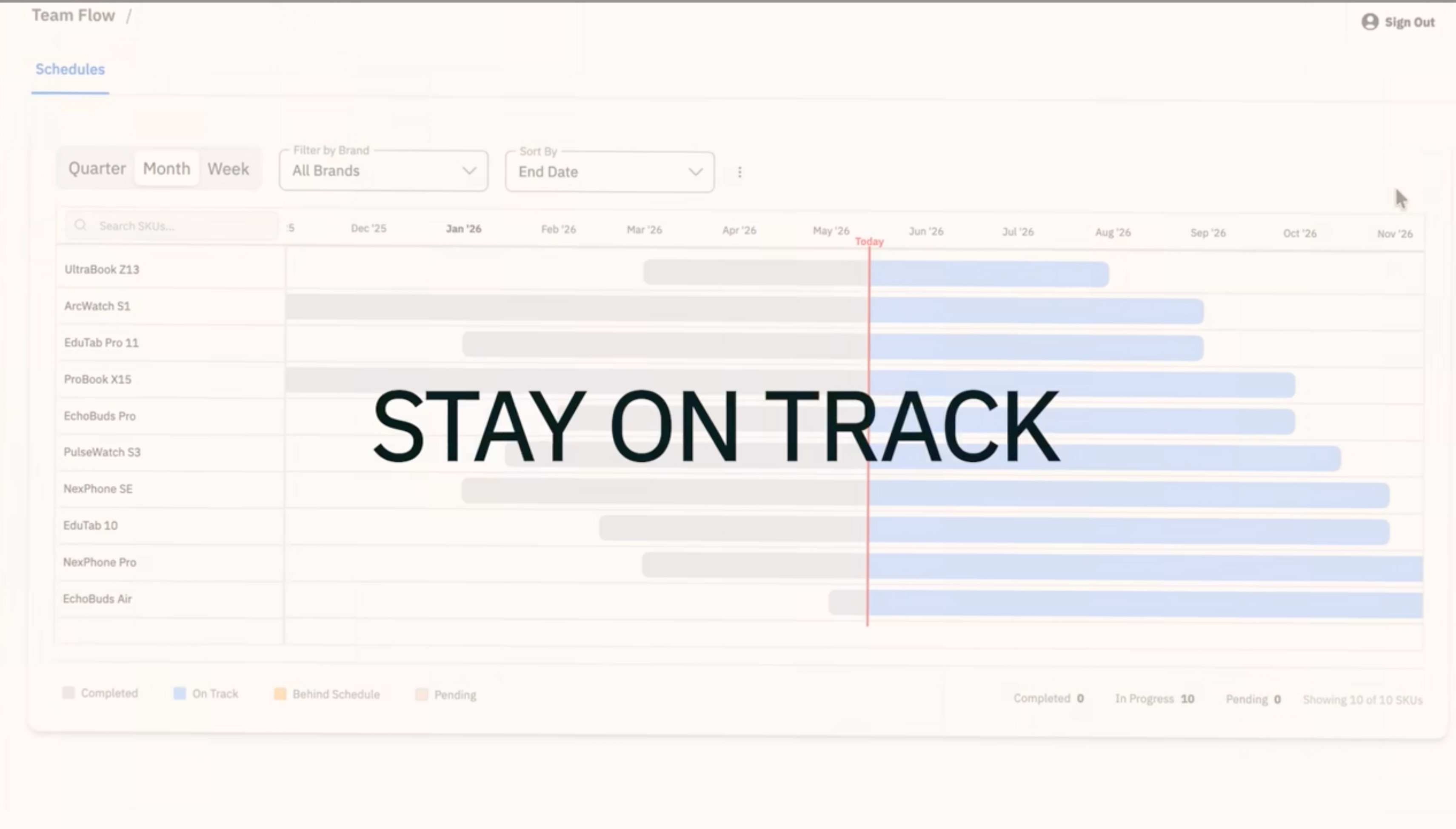
Again. And again. And again.
From the outside, it can seem like a simple question. But for hardware teams, answering it often requires pulling information from a dozen different places — PDM and PLM systems, spreadsheets, Gantt charts, project milestones, tickets, emails, Slack, and conversations happening across teams.
And as a hardware organization grows, this coordination problem gets exponentially harder.
The engineering team isn’t just building the product anymore. Senior engineers and product leaders increasingly become human status routers — constantly chasing updates, reconciling conflicting information, checking dependencies, and figuring out who needs to do what next.
That’s a huge amount of bandwidth spent on coordination rather than engineering.
We wanted to understand the problem better
Earlier this year, we spoke with dozens of hardware teams about this exact challenge.
One theme came up repeatedly:
Teams often find out about schedule risk much later than they should. We’ve talked about it here.
A part slips. A dependency changes. A milestone moves. Someone updates a spreadsheet but forgets to update another system. A conversation happens in Slack, but the relevant project tracker never gets updated.
Individually, these changes can look insignificant.
Together, they can put an entire project at risk.
So we’ve been building a different approach.
Meet Eve
We’re releasing a series of videos showing how our AI coworker, Eve, helps hardware teams stay on top of project coordination.
Eve starts with your project schedule and continuously works across the systems your team already uses.
Deadline alerts
Eve proactively identifies schedule risks and critical inconsistencies as soon as they appear — instead of waiting for the next status meeting to uncover them.
Multi-source validation
Eve cross-checks information across:
PDM / PLM
Spreadsheets and Gantt charts
Milestones and sprints
Tickets
Email
Slack and other team conversations
The goal isn’t simply to collect information.
It’s to determine what is actually happening.
Automated handoffs
When something starts slipping, Eve can follow your organization’s existing process for getting the schedule back on track.
That means less time figuring out who should do what and more time actually doing it, which we’ve touched on in our whitepaper.
Why does this matter?
1. Catch problems two weeks earlier
Finding out that a critical part is delayed today is very different from finding out two weeks before launch.
The earlier a risk is identified, the more options the team has to respond — and the less expensive the problem becomes.
2. Give engineering bandwidth back
Senior engineers and product leaders shouldn’t have to spend their days chasing status updates.
When coordination becomes automated, that time can go back toward engineering, product decisions, and solving the problems that actually require their expertise.
3. Make onboarding dramatically easier
Hardware organizations accumulate enormous amounts of process knowledge.
Who owns what? Where does the latest information live? What happens when a milestone slips? Which system is considered the source of truth?
Eve can capture and operate on that organizational knowledge, helping new team members ramp faster without repeatedly pulling senior engineers into the process.
And when someone leaves, the project history and coordination logic don’t leave with them.
4. Reduce meetings and Slack noise
A surprising amount of organizational communication exists simply because people need to stay synchronized.
More status meetings.
More “quick” Slack messages.
More follow-ups.
More people being added to threads just to make sure they know what’s happening.
Automating the coordination layer can eliminate a lot of that noise.
Built specifically for hardware
We didn’t build Eve as a generic AI assistant and then try to make it work for hardware.
We built it around the reality that hardware teams have messy, distributed, constantly changing sources of truth.
And because Eve can adapt to your organization’s specific sources, processes, and validation rules, getting it customized to your workflow can take less than 30 minutes.
You can essentially hire Eve to spend a month continuously coordinating your project, at a fraction of the hourly cost of an engineer.
We’re starting with the “Are we on track?” problem because it’s one of the most persistent coordination bottlenecks we’ve seen across hardware teams.
But ultimately, the goal is bigger:
Give engineering teams their bandwidth back.
If you’re building hardware and this sounds familiar, I’d love to hear how your team handles project coordination today.
And if you know a hardware team that is dealing with this problem, I’d really appreciate an introduction.
I’m also heading to Texas soon, with stops in Houston and Austin, to meet with hardware teams in person.
More videos on Eve’s approach are coming soon.